
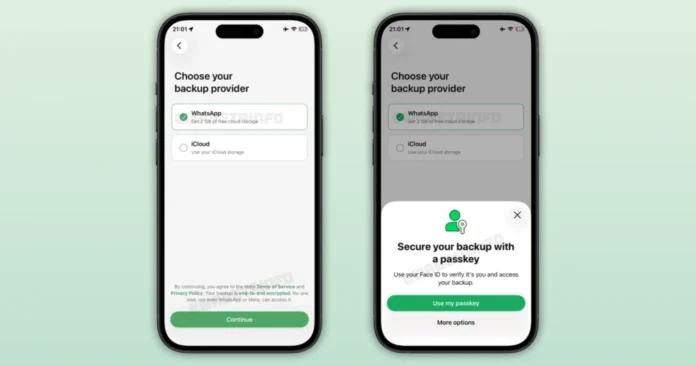
WhatsApp is working on its own cloud backup system for iPhone users. According to WABetaInfo, the feature was spotted in the WhatsApp beta for iOS 26.28.10.16, which is available on TestFlight. It is not ready for public beta testing yet, but the code confirms development is underway on both iOS and Android.
The idea is simple: instead of relying on iCloud to store your WhatsApp chat history, you would be able to store it on WhatsApp’s own servers. The feature mirrors what WhatsApp has already been building for Android, where Google Drive is the current default. That Android version was first reported back in April. Now WhatsApp is extending the same work to iOS.
This matters because iCloud storage fills up fast. Apple gives every user 5 GB for free, and that space has to cover photos, device backups, app data, and documents. WhatsApp backups, especially for users who send a lot of photos and videos, can eat through that limit quickly. Once you hit 5 GB, your only options are to delete files manually or pay Apple for more storage. The cheapest iCloud upgrade costs around $0.99 per month for 50 GB.
A dedicated WhatsApp backup option would take that pressure off iCloud entirely. Based on what WABetaInfo found, WhatsApp plans to offer 2 GB of free storage to start. That should cover most users with text-heavy chat histories. For those with larger backups, WhatsApp is also looking at paid plans:
- A 50 GB plan priced at around $0.99 per month
- A 1 TB plan for users who need significantly more space
Both the pricing and the storage tiers are still preliminary. WhatsApp could change them before any public release, so treat those numbers as early indicators rather than confirmed details.
One meaningful difference between this option and iCloud is how encryption works. On iCloud, end-to-end encryption for WhatsApp backups is optional. You have to turn it on yourself, and many users never do. On WhatsApp’s own servers, encryption is mandatory. There is no way to store a backup there without it being end-to-end encrypted, and there is no setting to turn it off.
WhatsApp recommends using a passkey as the encryption method. A passkey is a credential stored in your device’s password manager, and it replaces the need for a traditional password. Users who prefer not to use a passkey can still protect their backup with a regular password or a 64-digit encryption key. Either way, only the user can access the backup. WhatsApp and Meta cannot read it.
For a company owned by Meta, making encryption the default rather than an opt-in is a meaningful choice. Users who are uneasy about storing their chat history on Meta’s infrastructure will at least know it is protected by design, not just by policy.
If you switch to WhatsApp’s backup provider and complete your first backup there, it is still not clear what happens to your existing iCloud backup. It may not disappear automatically. If you want to reclaim that iCloud space, you can delete the WhatsApp backup manually by going to Settings, tapping your Apple account name, then iCloud, and finding WhatsApp in the app list.
There is also a longer-term possibility worth watching. Because WhatsApp would control the backup infrastructure directly, it could eventually allow users to restore a backup on a different platform. That would mean switching from an iPhone to an Android phone, or the other way around, without losing your chat history. WhatsApp has not confirmed this, and it is too early to count on it, but the architecture makes it more plausible than it has ever been.
iCloud will remain the default option for iOS users. Anyone who does not want to change anything will not need to. The new provider will simply appear as an alternative in the chat backup settings for those who want it. WhatsApp has not given a timeline for when this will reach beta or stable release.