
Microsoft just entered one of the most sensitive corners of enterprise tech, and it did so by claiming its new AI model beats every competitor on the benchmark that, according to Microsoft, everyone uses. That kind of circular self-promotion deserves a raised eyebrow before anything else.
As TechCrunch reported, Microsoft launched two products at a small San Francisco event: MAI-Cyber-1-Flash, its first cybersecurity-specialized AI model, and Perception, a new platform that deploys teams of AI agents to automate security workflows. Both are designed to identify and fix software vulnerabilities, and both are tied to MDASH, Microsoft’s internal system for software vulnerability identification and remediation.
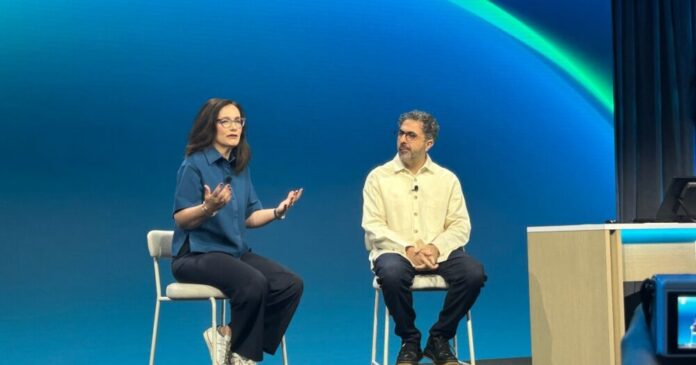
Mustafa Suleiman, CEO of Microsoft AI and co-founder of DeepMind, made the competitive positioning clear at the event. He claimed the combination of MAI-Cyber-1-Flash with GPT 5.4 inside the MDASH system outperforms models from Google and OpenAI on Cyber Gym, a benchmark he called “the golden benchmark.” He also said Microsoft is “shipping this into production immediately.” That is a bold claim, and it is worth asking what independent validation exists beyond Microsoft’s own test results.
Perception is the more structurally interesting product. It uses three types of agent teams: red teams that simulate attacks and model potential threat actors, blue teams that detect and triage existing bugs, and green teams that take corrective action. Dave Weston, Perception’s lead engineer, said the platform compresses what used to be hours of manual work by multiple security specialists into minutes, including discovery, prioritization, detection, and code fixes.
That efficiency pitch is real. Security teams are stretched thin, and AI tools that can triage vulnerabilities faster are genuinely useful. But “teams of agents” taking “corrective actions” on production code is also a description of automated systems making changes to infrastructure, often with minimal human review in the loop. For any organization considering this, the governance question matters as much as the speed claim.
The broader context is worth understanding. Anthropic launched its own security platform, Mythos, earlier this year through a limited partner program called Glasswing. OpenAI followed in May with its own offering through a program called Daybreak. Microsoft is now the third major AI lab to push into this space, which tells you where the money is flowing. Hayete Gallot, Microsoft’s VP for security, framed it as a necessity: defenders need to “fight AI with AI” because attackers are already using these tools at scale.
Perception and MAI-Cyber-1-Flash will be available in preview on November 3. Before then, organizations should be asking very direct questions about data handling, agent permissions, and audit logs. Because a platform that automatically rewrites your code based on AI decisions is only as trustworthy as the transparency behind it.