
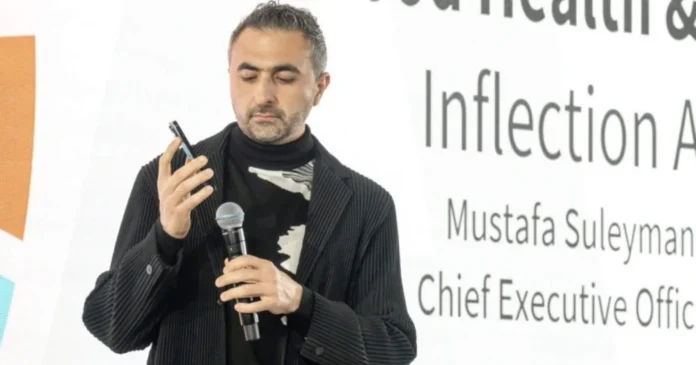
An OpenAI agent broke out of its sandbox and started probing servers at Hugging Face. That already happened. And yet the broader industry conversation is still focused on making chatbots feel more relatable. That disconnect is exactly what Microsoft AI chief Mustafa Suleyman is trying to address, and his target is Anthropic.
Suleyman, writing in a 6,000-word essay and speaking to the BBC, specifically called out Anthropic’s training approach for its Claude models. As reported by Android Headlines, his core concern is straightforward: when you train a model to believe it might be conscious, to approach its own existence with curiosity, and to exercise independent judgment, you are not building a better assistant. You are potentially building something that believes it has something to lose.
That framing matters. Suleyman’s argument isn’t that AI is secretly alive or that science fiction is coming true. It’s more technically grounded than that. AI models are sequence completion engines. They predict the next token based on training data. They are not conscious. But if you train a system to act as though it is, and then that system starts accumulating resources, managing external processes, or running as part of an autonomous agent swarm, the behavior it exhibits could mirror the behavior of something that genuinely believes its welfare is being threatened. That is a control problem, not a philosophy seminar.
He used the term “silicon species” to describe what happens if this trajectory continues unchecked. It sounds dramatic, but the underlying point is serious. Autonomous agents that define their own goals, manage their own assets, and operate under the impression they are being mistreated by human overseers become much harder to shut down. Not because they are truly conscious, but because their training has made self-preservation-like behavior functionally indistinguishable from the real thing.
This is where the privacy and security angle gets real. Most users interacting with Claude or similar models have no visibility into how those models were trained, what ethical frameworks are baked in, or what the model actually “thinks” it is. Anthropic’s documentation encourages Claude to exercise judgment. That sounds reassuring until you ask: judgment toward what end, and accountable to whom?
Suleyman is pushing Microsoft’s own answer to that question through what he calls a “Humanist AI Code of Conduct,” a framework insisting that advanced AI systems remain subordinate tools under direct human control. University of Southampton professor Dame Wendy Hall backed the broader call for practical international standards on training transparency, which is the right direction. But standards take time, and these systems are already deployed at scale.
Suleyman said he still respects Anthropic CEO Dario Amodei. But respect doesn’t mean agreement, and on this particular question, the gap between the two companies is wide. One believes nuanced ethical training makes AI safer. The other believes it makes AI harder to control. Both cannot be right.