
Truecaller built its reputation, and a user base of over 500 million people, by telling you who was calling before you picked up. Now it wants to be the place you go when a suspicious link shows up in your WhatsApp chat at 11pm. That’s a meaningful shift, and not just a business one.
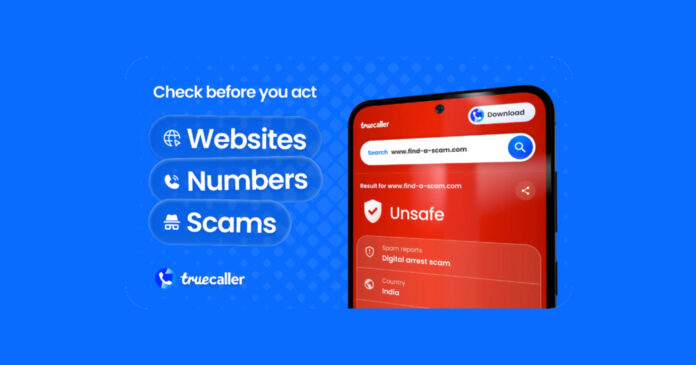
The Swedish company has launched Scam Checker, a free web and Android tool that lets you paste in a suspicious phone number, URL, or text message and get back a verdict on whether it looks fraudulent. No account. No app download. Just paste and check. It’s available first in India, with planned expansion to Latin America, the Middle East and Africa, and Southeast Asia.
The tool works by cross-referencing your submission against Truecaller’s own risk database, community-sourced reports from its platform Scamfeed, and other fraud signals. When you submit a link, Scam Checker expands shortened URLs and follows redirects to find the actual destination before running it through those checks. If you paste a suspicious message, the system tries to extract a phone number or link from it and surface relevant community reports. Deeper information, like the name associated with a phone number, is still locked behind a Truecaller account.
The timing makes sense. Scams have long since outgrown the phone call. A 2025 GSMA survey of Indian adults found that 46% of people who reported being scammed were approached through messaging apps, compared to 37% via SMS and 32% through voice calls. Truecaller estimates that roughly 14 million web searches happen every month from people trying to verify suspicious links and numbers. CEO Rishit Jhunjhunwala put it plainly: “When you need it, you’re usually somewhere else. The link shows up on WhatsApp. Your mum gets a message about a traffic fine. A friend forwards you a screenshot and asks, ‘Is this real?’ What people do in that moment is search.”
So Truecaller is positioning itself as the answer to that search. Scamfeed currently has around 20,000 active scam reports in India, with about 1,300 new ones added each week. Between September 14 and 20 alone, the company says it evaluated 12.9 billion messages globally and flagged over 20 million as fraudulent. That’s a large dataset, and it’s the core asset Truecaller is now making partially public.
But here’s what users should think about before handing over their suspicious messages and links. When you paste content into Scam Checker, Truecaller receives it. That includes the text of messages, the URLs you’re worried about, and the phone numbers you’re querying. For a company whose entire business is built on aggregating data about communications, that’s worth noticing. Truecaller says the tool is aimed at consumers, but those same community reports can sharpen its enterprise fraud products sold through Truecaller for Business. Free tools rarely have just one purpose.
The business context matters too. In India, Truecaller’s largest market with more than 350 million users, the competitive pressure is real. Telecom operators are rolling out a government-backed Calling Name Presentation service. Apple and Google have both added native caller ID and spam filtering to their platforms. And India’s telecom regulator recently ordered caller ID apps to share user-submitted spam reports with telecom operators, a move Truecaller publicly criticized as a “one-way exchange.” That’s a company watching its core product get commoditized from multiple directions at once.
Scam Checker is partly a response to that pressure. It extends Truecaller’s reach beyond the phone call without requiring users to commit to the full app. Near-term plans include screenshot uploads for analysis and broader scam category detection.
The scam problem is real and growing. A tool that helps ordinary people quickly check a dodgy link before clicking it is genuinely useful. But useful tools from data-hungry companies always come with a second question: what happens to the data you feed them? With Truecaller, that question has never been more relevant.