
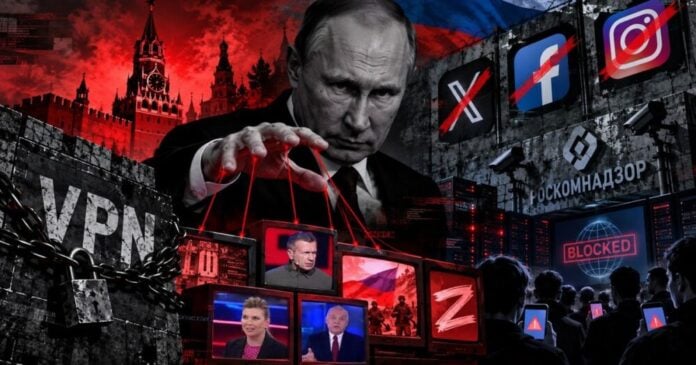
Russia wants to kill off nearly every VPN its citizens can reach. That’s not an exaggeration. According to Ukraine’s Foreign Intelligence Service, Roskomnadzor, Russia’s media and telecommunications regulator, has quietly set a target to block 92% of available VPN services by 2030. The order was reportedly pulled from public access once details leaked out. That alone tells you everything about how confident the Kremlin is in the legitimacy of what it’s doing.
The financial muscle behind this push is substantial. As reported by Defence Ukraine, Russia’s draft federal budget for 2027 to 2029 allocates roughly $238 million to its Automated System for Ensuring Internet Security in 2027 alone. That figure is double what was planned in the previous budget draft. Total funding for the system over the three-year period is expected to reach nearly $719 million.
But the censorship infrastructure is only part of the story. Russian authorities are also looking at using artificial intelligence to detect encrypted traffic and automatically block non-standard VPN protocols in real time. This is a meaningful technical escalation. Most VPN blocking to date has relied on identifying known services by their IP addresses or domain names. AI-driven traffic analysis targets the shape of the data itself, which makes circumvention significantly harder and puts users at greater risk of detection.
The crackdown is already producing results. In the week following Russia’s State Duma elections, access to at least 10 VPN services was restricted. So this isn’t a future plan sitting in a budget document. It’s already happening.
On the propaganda side, the numbers are even larger. The draft budget sets aside approximately $1.74 billion for state media and information support in 2027, a 45% increase over the previous draft. More than $153 million is also earmarked specifically for media and social media campaigns supporting Putin’s policy agenda. Over 2027 to 2029, total spending on these activities is projected to hit $4.07 billion.
To understand why this matters beyond Russia’s borders, consider the pattern. Since the full-scale invasion of Ukraine in 2022, Russia has blocked Facebook, Instagram, X, and dozens of independent news outlets. Messaging services have also been restricted. The combination of blocking outside information and flooding domestic channels with state-approved content is a well-documented model of information control. What’s changing now is the scale and the technical sophistication.
For privacy advocates and security researchers, the AI-assisted traffic analysis piece deserves close attention. If Russia develops working tools to detect and block obfuscated VPN traffic at scale, those tools don’t stay inside Russia’s borders. They get exported, licensed, or copied. Other authoritarian governments are watching.
VPN providers will need to respond, and some already are building obfuscation layers into their protocols. But it’s a difficult arms race, and ordinary users, especially those inside Russia trying to reach independent information, are the ones most exposed when the tools they rely on stop working.