
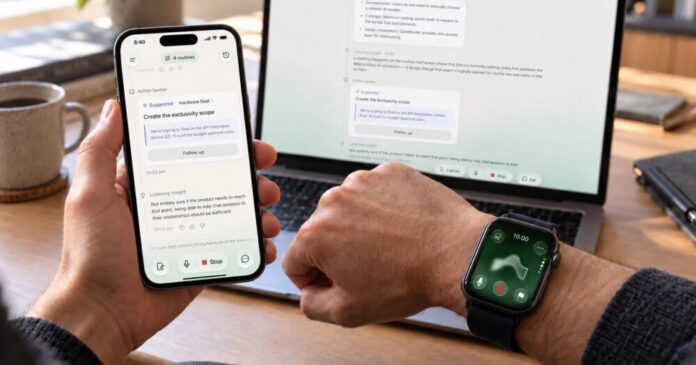
A single spoken sentence can end up in at least five different places before you finish your coffee. It becomes text, hits a server, drops into a document, feeds an AI model, and maybe gets retained indefinitely by a company whose privacy policy you never read. According to Android Headlines, voice data is one of the most underestimated security risks in both personal and professional settings, and the threat is growing as more people rely on speech-to-text tools for work.
The first question anyone should ask about a voice dictation tool is basic but rarely asked: where does the audio actually go? Some apps process speech locally on your device. Others send the recording to cloud servers, where a separate system handles transcription. That difference matters enormously. Cloud processing adds more connections, more companies, and more points of failure. If you are regularly dictating client details, business strategy, or anything sensitive, knowing whether your audio leaves your device is not optional, it is the starting point for evaluating any tool.
But here is what makes voice data more complicated than typed text. A recording picks up more than you intend. A colleague mentioning a client’s name in the background. A side comment you made before you started the actual dictation. A correction you mumbled and then deleted from the final transcript. All of that can exist in the raw audio file even when the finished document looks clean. Raw audio is its own data asset, and it should be treated that way, not dismissed as a temporary stepping stone to the transcript.
Data minimization is one of the most practical defenses available. If the only thing you needed was the transcript, there is little reason to keep the underlying audio. Businesses should build deletion schedules around actual purpose, not convenience or habit. Retaining everything indefinitely just means maintaining a growing collection of sensitive recordings that all need ongoing protection.
And deleting the audio does not close the loop. The transcript carries the same information. Once that text moves into email, cloud storage, project tools, or an AI workflow, the security controls have to follow it. A privacy-conscious recording step means nothing if the resulting document ends up in a shared folder with company-wide access.
Microphone permissions deserve more scrutiny than most users give them. Not every app on your phone or laptop needs to hear you. Reviewing and trimming those permissions is a small step with real impact. The same applies to who can access recordings and transcripts inside an organization. Permissions should match job responsibilities, and they should be reviewed when roles change.
There is also the question of synthetic voice. AI-generated audio can convincingly imitate a familiar voice, which makes voice alone a poor proof of identity for anything high-stakes. Requests involving money, credentials, or sensitive documents should go through a separate verification step, a known phone number, an approved channel, a formal process. Sounding like someone is not the same as being that person.
Voice data also raises specific concerns depending on what is being said. Consider the differences between these use cases:
- Drafting a marketing email, relatively low risk if audio is not retained
- Dictating legal advice or privileged client communications, high risk, requiring strict controls
- Customer service calls, often subject to retention rules and regulatory requirements
- Internal financial discussions, sensitive and potentially subject to compliance obligations
The tool that works fine for one of those scenarios may be entirely wrong for another. Organizations that let employees pick their own dictation apps without guidance are creating voice-data flows that security teams cannot see or assess. That is a structural problem, not a user error.
Voice is no longer just how humans talk to each other. It is a data format, and it deserves the same critical attention as any other.