
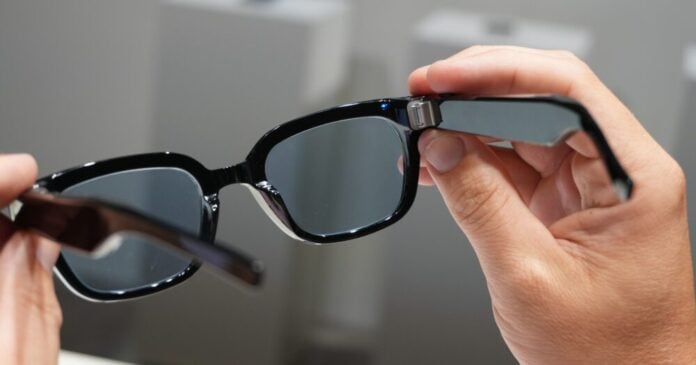
A camera on your face that looks like ordinary eyewear is a privacy problem. Streaming from it live, with no chance for anyone nearby to object, is a bigger one. Google seems to agree, at least for now.
According to SamMobile, Google Play’s policies for Intelligent Eyewear explicitly prohibit apps from using the glasses’ cameras for social live streaming. So if you buy the Warby Parker or Gentle Monster versions of Samsung’s glasses, you can’t broadcast your day to an audience in real time. You can record clips and upload them to YouTube later, as long as they follow that platform’s rules. But live streaming straight from the glasses is off the table.
The glasses also have an LED that lights up while recording. That’s a decent baseline. But an LED is a polite suggestion, not a guarantee. Plenty of people won’t notice a small light on a frame, and we’ve seen how easily such indicators get ignored or covered. The policy ban on live streaming is a stronger safeguard because it limits what apps can do, not just what bystanders might spot.
This is a clear split from Meta. Its Ray-Ban glasses support streaming directly to Instagram Live and Facebook Live, and Meta owns both services. That’s convenient for Meta, which gets more content flowing into its ecosystem. It’s less convenient for the people who happen to walk past the wearer. Meta’s approach treats bystanders as background material, and regulators in Europe and elsewhere have already started asking questions about that.
Don’t read too much virtue into Google’s stance, though. Alphabet owns YouTube, and SamMobile notes that YouTube live streaming could be added later. That would be a convenient exception, and it would test how firm this rule really is. A policy that bends for the owner’s own platform isn’t much of a privacy principle. It’s a product decision that happens to look good today.
Policies like this are also only as strong as their enforcement. Google Play rules govern apps distributed through the store. They don’t stop sideloaded software or determined workarounds, and the company hasn’t said how it will audit compliance on this hardware.
For now, Samsung’s glasses lean toward one-on-one video calls and Gemini-powered object recognition. Those features still send what the camera sees to cloud AI, which raises its own questions about data handling that the company hasn’t fully answered. Still, blocking public live streams is a real, if narrow, protection for everyone who didn’t choose to be filmed. It’s a trade-off. Live streamers lose a feature, and bystanders get a bit more breathing room.