
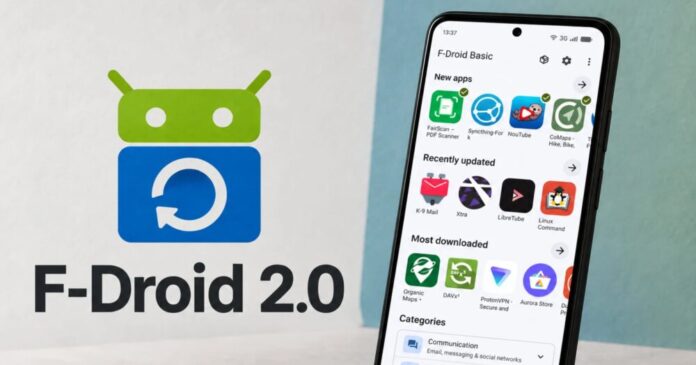
Ten years is a long time to go without a serious overhaul. F-Droid, the privacy-focused open-source app store for Android, has finally announced version 2.0, and on the surface it looks like the kind of update the project’s loyal users have been waiting for. But buried inside this release are some changes to core privacy features that deserve more attention than the shiny new interface is getting.
F-Droid has always been the alternative for Android users who don’t want Google Play tracking their every app install. It indexes free and open-source software only, and for years it has been the first stop for people serious about digital privacy. The problem is that the app has felt stuck in time, with clunky navigation and a search function that bordered on useless. Version 2.0, built over more than a year across 14 test builds, is a direct response to those complaints.
The redesign organizes everything into three main areas: Discover, Search, and My Apps. Categories have been expanded to include more specific groupings like VPNs, firewalls, and password managers. Search now pulls from app descriptions, categories, and translated content, not just app names, and results can be filtered by device compatibility and anti-features. Users searching in Chinese, Japanese, and Korean also get improved results. These are real, practical improvements for an app that previously made finding anything a minor ordeal.
The update management changes are significant too. F-Droid 2.0 uses a unified installer that supports Android’s pre-approval API, so compatible devices can approve an installation right after selecting an app rather than sitting through the full download first. Background updates can also run automatically based on your existing settings. That’s a meaningful quality-of-life improvement, bringing F-Droid closer to what mainstream app stores have offered for years.
But here’s where privacy advocates should pay attention. Tor support, one of the features that made F-Droid genuinely useful for high-risk users, has been simplified in ways that reduce its default protection. Automatic Tor detection is gone. The “Use Tor” option has moved to general proxy settings, and a Tor VPN is now the recommended approach instead. That’s a shift in responsibility from the app to the user. The disguise feature, meanwhile, only changes the app’s name and icon. F-Droid still shows up in Android’s settings, which matters if you’re trying to keep your privacy tools hidden from someone with physical access to your device. The panic-trigger wipe option is also still absent.
- Redesigned interface with Discover, Search, and My Apps sections
- Expanded categories including VPNs, firewalls, and password managers
- Search now covers descriptions, categories, and translated content
- Unified installer with Android pre-approval API support
- Automatic background updates based on user preferences
- Tor support simplified and moved to proxy settings
F-Droid says performance, accessibility, and usability improvements are coming in the months ahead. That’s a reasonable promise for a project of this size. But for the users who rely on F-Droid specifically because of its privacy properties, the version 2.0 trade-offs are worth understanding before updating.