
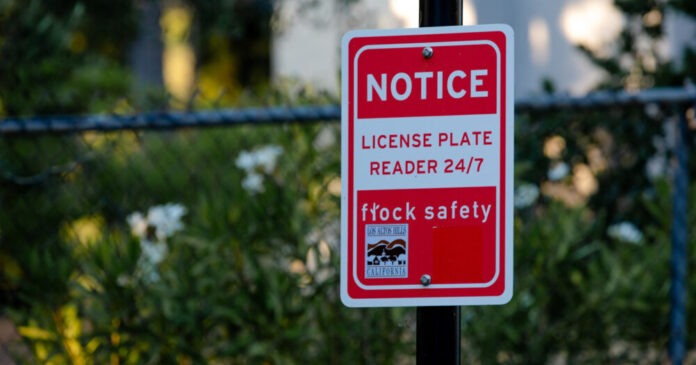
A quiet revolution in public surveillance has taken hold across the United States, and most people have no idea how far it reaches. Automated license plate readers, or ALPRs, have been installed along roads in cities and towns across the country for years. But the latest generation, led by a company called Flock Safety, is something different. These cameras don’t just read plates. They watch everything.
As reported by Engadget, there are now more than 100,000 Flock ALPRs installed nationwide. The company also sells AI surveillance cameras, mobile security trailers, and even quadcopter drones. All of them run on the same idea: type a description into a search box, and the system pulls up footage of anything the AI thinks matches. Think “green sedan with an American flag bumper sticker” or “pickup truck with a dirt bike in the bed.” No license plate needed.
Calling Flock cameras simple plate readers is like calling your eyes “article readers” just because that’s what you’re using them for right now. These are small computers running a modified version of Android. They wirelessly send footage to a central database, where AI catalogs everything for natural language searches by anyone with system access. That includes, in many cases, federal agencies like Immigration and Customs Enforcement, which gain access through data-sharing agreements with local police departments.
The scale of the network matters because it compounds every other problem. Flock contracts with cities, towns, neighborhoods, and private businesses. Many departments also connect to a nationwide network. The ACLU of Massachusetts has pointed out that police in Texas can search footage captured in Massachusetts. That’s not a bug in how Flock sells its product. It’s a feature.
The security record is troubling. Flock insists its cameras are secure, but independent researchers have repeatedly proven otherwise. Musician and YouTuber Benn Jordan, who has no formal cybersecurity background, has exposed multiple serious vulnerabilities. In December 2025, he found at least 70 Flock cameras exposed to the open internet, accessible through a commercial search engine with no password required. The live footage included children at parks and couples having private arguments in public.
Before that, Jordan and researcher John Gaines showed that anyone with physical access to a camera could press a button, connect over Wi-Fi, use standard Android development tools, and gain root access to the device. Exposed USB ports made things even easier. Installing malware was possible. Flock’s response to Jordan’s research was to call him part of “activist groups who want to defund the police, weaken public safety, and normalize lawlessness.” Most tech companies offer bug bounty programs for this kind of work. Flock chose a different approach.
Then there’s the misuse problem. According to reporting by 404 Media this month, dozens of documented cases have surfaced where police officers used Flock to track ex-girlfriends, current partners, and other individuals. In most cases, the stalking only came to light when victims searched their own plates using tools like HaveIBeenFlocked and discovered hundreds of lookups. Since the known cases are limited to officers who were caught and fired or arrested, the real number is almost certainly higher. Flock told 404 Media that 15 abuse incidents had surfaced thanks to its own “transparency and accountability features.”
Separate reporting from 404 Media found that Flock employees had been watching children swim and attend gymnastics classes at the Marcus Jewish Community Center of Atlanta, then showing those camera feeds to police departments as part of sales demos. Flock defended the employees, saying they had accessed the camera network with the city’s permission as part of their job.
Innocent people have also been caught in the crossfire. In Denver, Colorado, a financial advisor named Chrisanna Elser answered her door to find a police officer with a theft summons. The officer told her, “You can’t get a breath of fresh air in or out of that place without us knowing.” Elser was able to prove her innocence using footage from her Rivian’s built-in cameras, which showed she had never stopped in the area where the package was stolen. The charges were dropped. Others in Colorado have been pulled over because a Flock camera mistook a zero for the letter O on a license plate. At least one driver told local news that he fears for his safety every time a Flock camera picks up his vehicle, and police said they couldn’t remove him from the system’s hotlist.
Despite all of this, cities keep buying in. The reasons come down to a few basic dynamics:
- Flock markets directly to law enforcement and city officials, not to the public
- The cameras are sold as powerful crime-deterrence tools, despite little evidence they reduce crime
- Contracts are written to make cancellation difficult or legally risky
- Residents, especially those from communities most likely to be targeted by AI surveillance, often have no vote in the decision
Denver is a good example. The city installed 111 cameras in May 2024. When the contract came up for renewal in 2025, the city council voted unanimously against extending it. Mayor Mike Johnston overruled that vote. He defended the decision by claiming Flock cameras had helped solve the murder of a transgender woman named Jax Gratton. That claim was false on two counts: Flock had not assisted in the case, and no arrest had even been made. Gratton’s mother publicly demanded an apology.
Denver eventually cancelled its Flock contract after sustained public protest, a packed town hall, and national attention. Then it awarded the replacement contract to Axon, a company that already supplies body cameras to police departments across the country.
Getting out of a Flock contract isn’t easy. When Dayton, Ohio and Evanston, Illinois tried to end their deals, both cities worried that physically removing the cameras might count as a breach of contract. Their solution was to cover the cameras with garbage bags while they worked out the legal question.
If you want to know whether Flock cameras are operating near you, DeFlock is an open-source tool with a public map tracking ALPR installations across the country. The map keeps growing.