
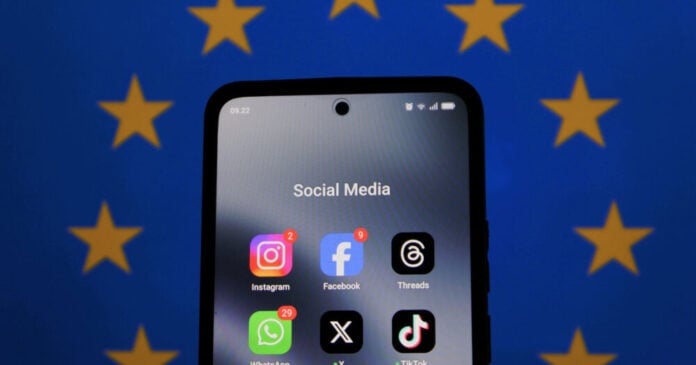
The European Union is taking its most serious steps yet toward blocking children from using social media. EU Commission president Ursula von der Leyen announced the move at a press conference on July 13, 2026, citing a new expert report that paints a troubling picture of how much time children across the continent spend on platforms like TikTok and Instagram.
“It is clear we need age-appropriate restrictions to platforms,” von der Leyen said. “This is not about whether children can access social media. It is about whether and when social media can access our children.” The statement signals a shift in how European leaders are framing the debate, moving away from parental choice and toward treating platforms themselves as the problem.
The report, written by child psychologist Dr. Jorg M. Fegert and epidemiologist Dr. Maria Melchior, found that children across Europe now spend four to six hours per day on social media. Nearly 60 percent of them showed signs of “socio-emotional development” problems, including sleep disruption, difficulty concentrating, and higher rates of depression and anxiety. These are not edge cases. These numbers point to a pattern affecting a large share of an entire generation.
Based on those findings, the report puts forward a clear set of recommendations:
- Children under 13 should only access social media with supervision from a parent or teacher
- Teens aged 13 to 18 should only use platforms that include safety features such as limits on infinite scrolling
- Children under three should have no screen access at all
Europe would not be the first to act. Australia passed a law banning children under 16 from social media, making it the first country in the world to do so. France, Germany, and Spain are all looking at similar measures. In the United States, Florida banned social media use for children under 14 without parental approval back in 2024.
Australia’s approach has drawn criticism. Opponents argue that kids can work around the rules simply by lying about their age or creating fake accounts. The Australian government has responded by pushing harder on enforcement, recently announcing it will double the maximum penalty for platforms that break its minimum age law, raising the ceiling to 99 million Australian dollars, roughly $68 million USD.
If Europe follows through, the scale would be far bigger than anything attempted so far. The EU has around 450 million people, with roughly 81 million under the age of 18. A law covering all of them would be the largest effort of its kind anywhere in the world. But getting there will not be simple. Any new legislation would need agreement from all 27 member states, a process that takes time and involves significant political negotiation.
Von der Leyen suggested the report could be a turning point. “The more we learn, and the more we see the impact on our children, the stronger the argument becomes for a social media start date,” she said. The EU Commission will now review the report and its recommendations, with a formal proposal expected “after the summer.” That timeline is vague, but the political pressure behind it is real. With multiple countries already moving in this direction, the question for European regulators may no longer be whether to act, but how fast.