
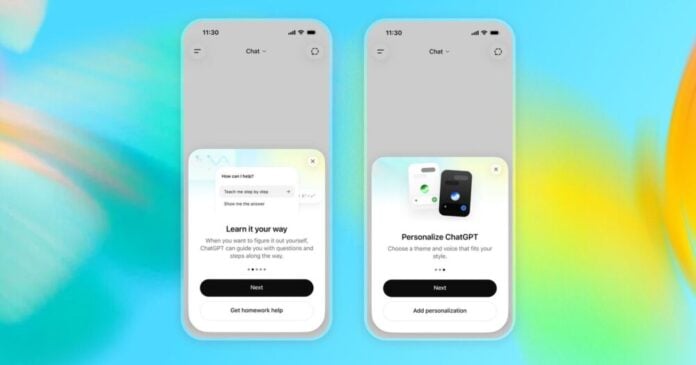
Almost a year after OpenAI was sued over the alleged role ChatGPT played in the death of 16-year-old Adam Raine, the company has announced a dedicated experience for younger users called ChatGPT for Teens. It starts rolling out globally today, with a full rollout expected within two weeks. The timing isn’t coincidental. Public pressure, legal exposure, and a wave of criticism over AI companies marketing emotionally engaging chatbots to minors have all pushed this moment forward.
The feature is built around two stated goals: better learning tools and tighter safety guardrails. On the learning side, OpenAI is leaning heavily on Study Mode, a Socratic-style interaction model where ChatGPT guides users toward answers rather than just handing them over. It won’t be the default setting, but OpenAI is adding features designed to nudge teens toward it. A new tool called Study Hours lets parents or teens schedule windows when Study Mode turns on automatically. Even outside those windows, ChatGPT will now detect when a young user appears to be looking for homework answers and try to redirect them.
OpenAI says Study Mode has shown “positive gains in performance” across randomized controlled trials, though Lauren Jonas, the company’s head of youth and families, declined to share specific numbers. That’s a frustrating non-answer. If the data is strong enough to inform OpenAI’s broader educational strategy, it’s strong enough to publish. Still, the underlying feature has expanded. ChatGPT can now generate explanatory visuals across more than 300 topics, up from 70 at launch in March, covering subjects like mitosis, integrals, and moon phases.
The safety side of ChatGPT for Teens is where things get more interesting, and more complicated. OpenAI says it is actively restricting the chatbot’s ability to blur the line between tool and companion. The model won’t call itself a friend, claim to have feelings, or suggest it is sentient when talking to a teen user. Break reminders will now explicitly note that ChatGPT is an AI, and those reminders will appear more often. Parents and teens can also set quiet hours when the chatbot is simply unavailable.
OpenAI is also expanding its parental notification system. It already alerts parents through linked accounts when a teen is removed from the platform for making violent threats. Now, the company is adding alerts tied to eating disorder-related conversations. Any exchange that signals “serious self-harm concerns” can trigger a notification sent via text, in-app message, and email. Jonas says all flagged content is reviewed by full-time OpenAI employees before a parent is contacted, and the company aims to send alerts within an hour.
The key features of ChatGPT for Teens include:
- Automatic enrollment for users identified or confirmed as under 18
- Study Mode with Socratic-style responses and scheduled Study Hours
- Restrictions on the model expressing emotions, claiming sentience, or calling itself a friend
- More frequent break reminders that reinforce the tool’s AI nature
- Quiet hours that disable access entirely
- Expanded parental notifications covering violent threats and eating disorder conversations
But the biggest open question is one Jonas didn’t fully answer: how reliable is the age detection system? OpenAI says it will automatically identify teens based on behavioral signals and account data. No age-gating system is foolproof. Discord, Roblox, and other platforms have found this out the hard way, with younger users regularly finding workarounds. There’s no reason to assume ChatGPT will be different. OpenAI is betting on a system that has never been publicly tested at scale, to protect a group of users it has a legal and ethical obligation to get right.
Jonas acknowledged that this launch is a starting point, not a solution. “Safety work is never finished,” she said. That’s probably the most honest thing OpenAI has said about this whole effort. The pressure to protect teens from AI tools that are increasingly designed to feel personal and emotionally engaging is real, and growing. ChatGPT for Teens is a meaningful step. Whether it’s a sufficient one is a different question entirely.