
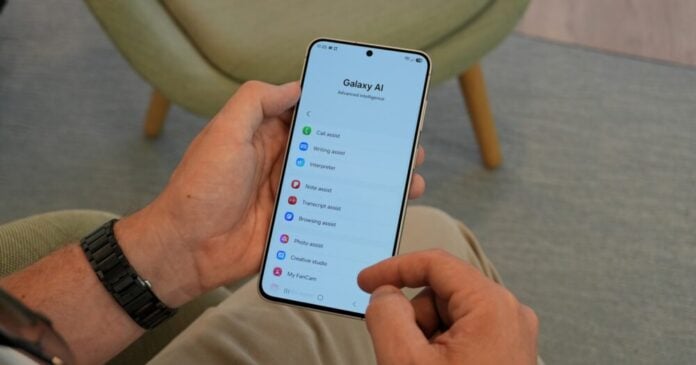
Samsung wants to catch deepfakes on your phone before they reach the cloud. Good idea. Just don’t expect it on yours any time soon.
Samsung Electronics Singapore has partnered with Reality Defender, a New York-based AI detection company, to develop and deploy on-device detection of AI-generated voice, video and images. The work involves the Samsung Knox team. The target is enterprise customers in Singapore, who would be able to flag suspect content on their Galaxy devices before they act on it. The tools are planned for the Galaxy S26 series and later models, plus the latest Galaxy Tabs.
The on-device part is the interesting bit for privacy. Analyzing media locally means audio and video don’t have to be shipped to a third-party server just to be checked. That’s the right design instinct. But the announcement doesn’t say how much processing really stays on the handset, what telemetry flows back to Samsung or Reality Defender, or whether detection results get logged by an employer’s device management. Enterprise tooling tends to come with admin dashboards, and a scanner that inspects every call and video on a work phone is also a monitoring surface. No technical details were shared, so those questions are open.
The motivation is real, though. Citing a 2024 survey, Samsung says 56% of businesses in Singapore have faced AI-generated audio fraud attempts, and 52% have dealt with video deepfakes. In 2025, AI scam victims in Singapore lost roughly S$242 million, about $188 million. Those are vendor-cited numbers, so treat them as directional, but the trend matches what fraud investigators keep reporting: cloned voices and fake video calls are cheap to produce and hard for people to spot.
This fits a broader pattern. Critics argue AI companies aren’t doing enough to separate human-made content from synthetic content, so the burden lands on whoever receives it. Detection vendors are filling that gap, and phone makers are now bundling them in. Detection is also an arms race. Classifiers trained on today’s generators miss tomorrow’s, and false positives can be as damaging as misses when a real voice gets flagged as fake.
Whether consumers get anything similar is unknown. Samsung hasn’t said it will bring this to regular Galaxy phones and tablets, and only time will tell. If it does, the questions to ask are simple. Does it run offline? Is it opt-in? What gets sent anywhere? Until Samsung answers those, this is a Singapore enterprise pilot, not a protection for the rest of us.